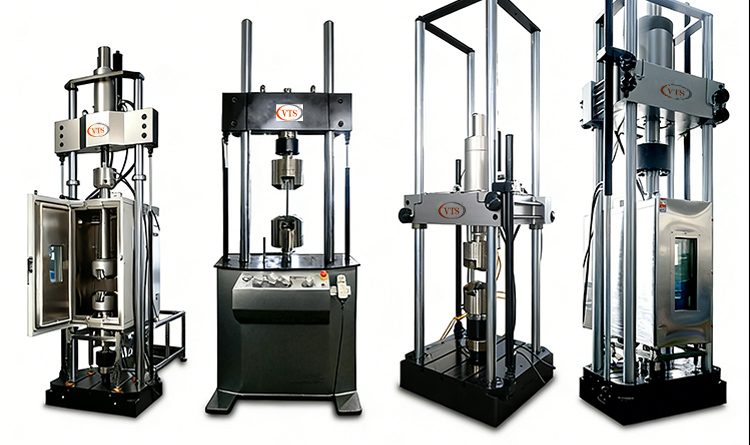
BS 7448 Dynamic and Static Testing Machines
BS 7448 Dynamic and Static Testing Machines
(Fracture mechanics toughness – Dynamic/Fatigue Testing Machines)

BS 7448 Detailed Test Methods and Machine Requirements
BS 7448 is a British standard for fracture mechanics toughness testing. It is a multi-part document, primarily used to determine the fracture toughness parameters (stress intensity factor K, critical crack tip opening displacement CTOD, critical J integral) of metallic materials and welded joints. It is widely used in the safety assessment of critical welded structures such as offshore platforms, oil and gas pipelines, and pressure vessels. Below is a detailed summary of the test methods and corresponding machine requirements for each part, compiled by the VTS team.
Core Test Methods (Taking the CTOD test as an example, including common requirements for each part) BS 7448 Dynamic and Static Testing Machines
The test methods in BS 7448 follow the core process of “specimen preparation – fatigue pre-crack – loading test – data processing – validity determination.” Among these, the CTOD test (Crack Tip Opening Displacement Test) is the most widely used core test type. The following details its general process and specific requirements for each part:
Specimen Preparation
Specimen preparation is fundamental to ensuring test validity. BS 7448 has strict regulations regarding specimen type, size, notch location, and machining accuracy:
1. Specimen Type: The three-point bending (TPB) standard specimen is preferred. In some scenarios, a compact tensile specimen can be used (suitable for high-constraint, high-stress conditions);
2. Size Requirements: Taking a typical thick plate test as an example, the three-point bending specimen has a width W = 127 mm, thickness B = 62 mm, length L = 550 mm, and span S = 112B (different thicknesses require adjustment according to the standard ratio);
3. Notch Machining:
– Use 0.12 The notch is machined using a 1 mm molybdenum wire cutter. The notch in the weld specimen is located at the nominal weld centerline, and the notch in the heat-affected zone is 0-1 mm from the fusion line.
– The depth of the mechanical notch is approximately 45% of the specimen width W to ensure the total crack depth meets requirements after subsequent pre-existing fatigue cracking.
4. Material and Welding Requirements: The base material, welding process (e.g., SMAW, SAW), and bevel type (X-type, K-type, atbp.) must be clearly defined. For multi-layer welds, the number of weld passes must be no less than 24 (for thick plates).
Fatigue Pre-crack Preparation
The aim is to prepare sharp, uniform fatigue cracks based on mechanical notches, simulating the crack morphology in actual structures. Specific requirements are as follows:
1. Equipment: A high-frequency fatigue testing machine with precise load control and cycle recording capabilities is required.
2. Process Parameters: Fatigue loading is performed at room temperature using symmetrical or asymmetrical cycles to ensure stable crack propagation.
3. Crack Quality Requirements:
– Base material specimens: Average crack depth a₀ = 0.45~0.55W, depth difference between any two points at the crack tip ≤ 10%a₀;
– Welded joint specimens: Average crack depth a₀ = 0.45~0.70W, depth difference between any two points ≤ 20%a₀;
– The minimum pre-crack size should not be less than the larger of 1.3 mm and 2.5%W, and the angle between the crack propagation direction and the wire-cut notch plane should be ≤ 10°;
4. Residual stress control: Local compression methods (such as double-sided indentation treatment, with a pressure block diameter of φ30 mm and an indentation load of 70 kN) should be used for weld specimens to reduce residual welding stress and prevent crack propagation.
Loading Test and Data Acquisition
Select the appropriate loading method based on the test scenario (normal temperature/low temperature, static/dynamic). The core process is as follows:
1. Environmental Control:
– Low Temperature Test: The sample must be placed in a temperature chamber, and the temperature must be controlled according to standard requirements (e.g., -18℃ is commonly used for offshore platform scenarios, and -15℃ is commonly used for pipeline steel scenarios). The holding time must ensure uniform temperature across the entire sample.
– Normal Temperature Test: The ambient temperature is controlled between 5~40℃, and the relative humidity is ≤90%.
2. Paraan ng Pag load:
– Static Loading (Part 1, Part 2): Loading is performed in one pass until the sample becomes unstable and fails. The loading rate is controlled between 0.5~1.0 mm/min.
– Dynamic Loading (Part 3): The stress intensity factor growth rate must be >3.0 MPa·m/s. A dynamic testing machine is used to achieve rapid loading.
3. Data Acquisition: The load-displacement (P-V) curve is recorded in real time using a data acquisition system. Parameters such as loading rate, ambient temperature, and displacement changes are collected synchronously. The data sampling frequency must meet the requirements for crack propagation monitoring.
Core Requirements for Testing Machines
BS 7448 specifies clear requirements for the accuracy, rigidity, control capabilities, and auxiliary functions of testing machines. The machine requirements for different testing stages are as follows:
Dynamic/Fatigue Testing Machines (For Fatigue Pre-crack Preparation)
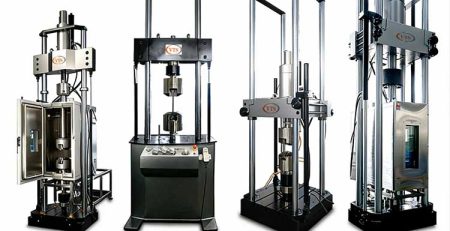
1. Type: High-frequency fatigue testing machines are preferred, characterized by simple structure, high efficiency, and low energy consumption. They can perform symmetrical, asymmetrical, or unidirectional pulsating fatigue tests.
2. Performance Requirements:
– Katumpakan ng Pagkarga: Dynamic load control accuracy ≤ ±1%, capable of stably outputting preset cyclic loads;
– Rigidity: The machine body must possess high rigidity to prevent deformation during loading, which could affect crack propagation stability;
– Control Functions: It must have computerized load control, cycle count recording, and automatic shutdown functions, and be able to monitor crack propagation status in real time;
– Environmental Adaptability: It must be adaptable to high and low temperature environments to meet the fatigue pre-crack requirements at different temperatures;
3. Compliance: It must comply with DIN EN ISO/IEC 17025 and JB/T Standard 5488-1991 requirements.
Universal na pagsubok machine (For Static Loading Testing)
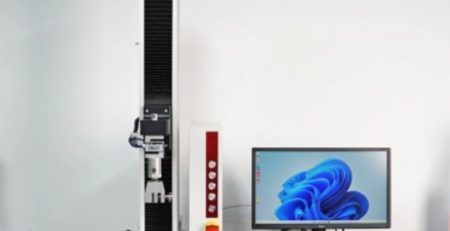
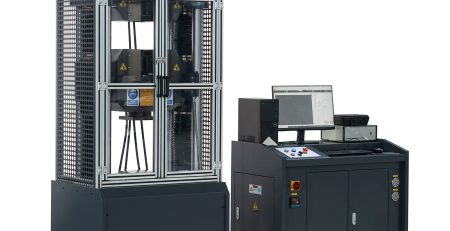
1. Core Functions: Possesses quasi-static loading capability, enabling three-point bending or compact tensile loading modes;
2. Performance Requirements:
– Loading Accuracy: Loading rate control accuracy ≤ ±0.05 mm/min, capable of stably maintaining a standard loading rate of 0.5~1.0 mm/min;
– Load Measurement: Equipped with a high-precision load sensor, load measurement accuracy ≤ ±0.5%, the range must cover the expected failure load of the specimen (e.g., for thick plate tests, it must have a load capacity of hundreds of kN);
– Displacement Measurement: Equipped with an extensometer, displacement measurement accuracy ≤ ±0.001 mm, capable of real-time acquisition of displacement changes at the specimen notch;
– Stiffness and Stability: High machine body stiffness, no creep during loading, ensuring the accuracy of load-displacement data;
BS 7448 Dynamic and Static Testing Machines/Dynamic Testing Machine (Part 3: For Dynamic Loading)
1. Performance Requirements: Must possess rapid loading capability, capable of achieving a stress intensity factor growth rate > 3.0 MPa·m/s;
2. Control and Acquisition: Equipped with a high-speed data acquisition system, sampling frequency ≥1000 Hz, capable of capturing instantaneous load and displacement changes during dynamic loading;
3. Safety Protection: Possesses comprehensive safety protection devices to prevent sample fragments from splashing during dynamic loading.
Environmental Control Equipment
1. Temperature Chamber:
– Temperature Control Range: Covers -40℃ to ambient temperature (meets low-temperature testing requirements), temperature control accuracy ≤±1℃;
– Uniformity: Temperature uniformity within the chamber ≤±2℃, ensuring consistent overall sample temperature;
– Adaptability: Internal space can accommodate standard-sized samples and loading fixtures without affecting loading operations;
2. Special Environmental Devices (if required): For corrosive or high-temperature environment tests, appropriate environmental simulation chambers (such as corrosive gas environment chambers, high-temperature heating furnaces) are required to meet the BS 7448 extended testing requirements.
Measurement and Auxiliary Equipment
1. Data Acquisition and Processing System: Equipped with real-time data recording, storage, and analysis functions, capable of automatically generating load-displacement curves, and supporting automatic calculation of K, CTOD, and J values;
2. Calibration Equipment: Regularly calibrate the testing machine, sensors, and measuring instruments to ensure the traceability of measurement results. Calibration standards must comply with national or international metrological standards;
3. Fixtures and Tooling: Equipped with dedicated three-point bending specimen fixtures and compact tensile specimen fixtures. The fixtures have high rigidity and precise positioning, ensuring uniform stress distribution during specimen loading.
Precautions for Standard Application
1. Strict control of specimen temperature is essential during testing, especially in low-temperature tests. Insufficient holding time will lead to uneven specimen temperature, affecting test results.
2. Fatigue pre-crack formation is a critical step in the test. The sharpness and uniformity of the cracks directly determine the test validity. Precise control of loading parameters using a high-frequency fatigue testing machine is necessary.
3. The test report must fully record specimen information, test parameters, measurement data, and validity assessment results. If the validity requirements are not met, the reasons must be noted, and the test must be repeated.
For more details about the Dynamic testing machine, paki contact na lang po:
📩 andy@victorytest.com
📞 WhatsApp: +8615305307234
🌏 www.vtstestmachine.com
Our team is made up of dedicated professionals who are passionate about technology and delivering the best solutions and services to our customers.