Σύνθετα πλαστικών ενισχυμένων με ίνες-Προσδιορισμός των ιδιοτήτων εφελκυσμού
Σύνθετα πλαστικά ενισχυμένα με ίνες – Προσδιορισμός ιδιοτήτων εφελκυσμού
Tensile test methods for fiber reinforced plastics
Fiber reinforced plastics (FRP) έχουν χρησιμοποιηθεί ευρέως στην αεροδιαστημική, κατασκευή αυτοκινήτων, κατασκευή, αθλητικός εξοπλισμός και άλλα πεδία λόγω των εξαιρετικών μηχανικών ιδιοτήτων τους, ελαφρύ βάρος, υψηλή αντοχή και καλή αντοχή στη διάβρωση. Ωστόσο, Οι μηχανικές ιδιότητες του FRP εξαρτώνται σε μεγάλο βαθμό από την ισχύ διεπιφανειακής σύνδεσης μεταξύ των εσωτερικών ινών και του υλικού της μήτρας και της κατανομής προσανατολισμού των ινών. Επομένως, accurate mechanical property testing of FRP, especially tensile testing, is of great significance for evaluating its reliability and durability in practical applications.
1. Importance of tensile testing of fiber-reinforced plastics
Fiber-reinforced plastics have been widely used in the automotive, αεροδιαστημική, construction and other fields, and are favored for their high strength, light weight and corrosion resistance. In order to ensure the quality of this material, tensile testing is required to determine its strength, toughness and ductility. The tensile test standards for fiber-reinforced plastics mainly include ASTM D638, ISO 527 και GB/T 1040.
2. ASTM D638 standard
ASTM D638 is a standard issued by the American Society for Testing and Materials (ASTM) for uniaxial tensile testing of plastic materials. The standard specifies the size and geometry of the specimen, συνθήκες δοκιμής, data processing methods, και τα λοιπά. The specified specimen shapes include standard specimens, thickness specimens and thin plate specimens, and the test data include maximum load and elongation at break.
3. ISO 527 πρότυπο
ISO 527 is a standard issued by the International Organization for Standardization for tensile testing of various types of plastic materials. Compared with the ASTM D638 standard, the specimen shape of the ISO 527 standard is more flexible and can be adjusted as needed. The standard includes four test methods, which are applicable to different types of materials, including plastics, fiber-reinforced plastics, films and rigid plastics.
4. GB/T 1040 Πρότυπο
GB/T 1040 is a Chinese national standard applicable to tensile tests on plastic materials. Compared with ASTM D638 and ISO 527 πρότυπα, this standard differs in test methods, number of specimens, επεξεργασία δεδομένων, και τα λοιπά. Για παράδειγμα, parameters such as specimen tensile speed, test temperature and humidity are specified in the test method. Συγχρόνως, in terms of data processing, the standard also specifies methods for calculating breaking strength and elongation.
Σύνθετα πλαστικών ενισχυμένων με ίνες-Προσδιορισμός των ιδιοτήτων εφελκυσμού
1. Detection principle
A static tensile load is applied uniformly along the axial direction of the sample until the sample breaks or reaches a predetermined elongation. During the whole process, the load applied to the sample and the elongation of the sample are measured to determine the tensile stress (tensile yield stress, tensile fracture stress or tensile strength), tensile elastic modulus, Poisson’s ratio, fracture elongation and draw stress-strain curves.
2. Πρότυπο δοκιμής
GBT 1447-2005 Test method for tensile properties of fiber reinforced plastics
3. Δοκιμαστικά είδη
1. Tensile stress: the ratio of tensile load to initial cross-sectional area within the gauge range of the sample
2. Tensile yield force: the initial stress in which strain increases but stress does not increase during the tensile test, which may be lower than the maximum stress that the sample can reach.
3. Tensile fracture stress: the tensile stress at which the sample breaks during the tensile test.
4. Tensile strength: the maximum stress that the material withstands before tensile fracture.
5. Tensile strain: the rate of change of length within the gauge range of the sample under the action of the tensile load.
6. Tensile yield strain: The tensile strain at the yield point of the specimen that yields during the tensile test.
7. Tensile fracture strain: The tensile strain when the specimen fractures under the tensile load.
8. Tensile elastic modulus: The ratio of tensile stress to tensile strain within the elastic range of the material.
9. Poisson’s ratio: The absolute value of the ratio of the lateral strain caused by the uniformly distributed axial stress to the corresponding axial strain within the proportional limit range of the material; the relative elongation within the gauge length range when the specimen fractures under the action of tension.
Σύνθετα πλαστικών ενισχυμένων με ίνες-Προσδιορισμός των ιδιοτήτων εφελκυσμού
IV. Testing instruments
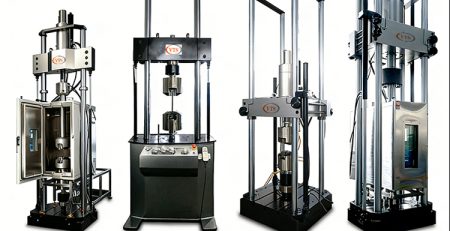
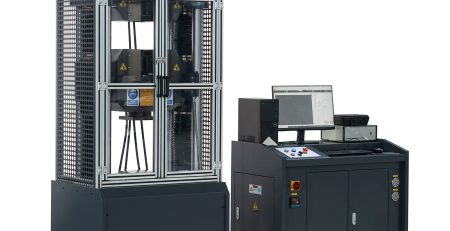
1. Universal material testing machine
(Schematic diagram: The universal material testing machine can be used with different fixtures for different mechanical tests)
2. Wedge fixture
3. Reinforcement sheet (applicable to type II specimens)
A.1 Reinforcement sheet material
Use the same material as the specimen or a material with a lower elastic modulus than the specimen.
A.2 Reinforcement sheet size
Thickness: 1mm~3 mm;
Πλάτος: The width of the specimen when a single specimen is bonded; if the specimen is processed into a single specimen after integral bonding, the width must
Meet the requirements of the number of specimens to be processed.
A.3 Bonding of reinforcement sheet
Grind (or sandblast) the bonding surface with sandpaper. Be careful not to damage the material strength;
Clear the bonding surface with a solvent (such as acetone);
Bond with a room temperature curing adhesive (such as epoxy adhesive) with good toughness;
Pressure the bonding part of the specimen for a certain period of time until the curing is completed.
4. Customized fixture for type III specimens
4. Συνθήκες δοκιμής
ένα. Specimen type:
Type I specimen (dumbbell shape): 180×10×(2~10)mm, 10τεμ
Type II specimen: 250×25×(2~10)mm, 10τεμ
Type III specimen: dog bone type, 7τεμ
Poisson’s ratio specimen
2. Θερμοκρασία δοκιμής
Room temperature
3. Ταχύτητα δοκιμής
When measuring tensile elastic modulus, Poisson’s ratio, elongation at break and drawing stress-strain curves, the loading speed is generally 2mm/min.
When measuring tensile stress (tensile yield stress, tensile fracture stress or tensile strength):
ένα) In conventional tests, the loading speed of type I specimens is 10mm/min; the loading speed of type II and sub-type specimens is 5mm/min;
σι) In arbitration tests, the loading speeds of type I, II and III specimens are all 2mm/min.
IV. Διαδικασία δοκιμής
Step 1. Equipment and tool preparation
Ensure that the universal material testing machine operates normally, and the fixture is installed in place and without damage.
Step 2. Προετοιμασία δείγματος
Prepare type I specimens (dumbbell-shaped) 180×10×(2~10)mm, 10pcs in total, type II specimens 250×25×(2~10)mm, 7pcs in total, and Poisson’s ratio specimens as required.
Inspect the appearance of the specimens to ensure that there are no obvious defects, and follow the provisions of 4.2 in GB/T1446-2005.
Adjust the state of the specimens in accordance with the provisions of 4.4 in GB/T1446-2005.
Number and mark the qualified specimens, and measure the width and thickness of any three points in the working section of the specimens, take the arithmetic mean, and the measurement accuracy shall be in accordance with the provisions of 4.5.1 in GB/T1446-2005.
Step 3: Bond the reinforcing sheet
Use sandpaper to polish (or sandblast) the bonding surface at both ends of the Type II specimen, taking care not to damage the material strength.
Use solvents such as acetone to clean the bonding surface to remove grease and impurities.
Use a room temperature curing adhesive with good toughness (such as epoxy adhesive) to bond the reinforcing sheet to both ends of the Type II specimen, and pressurize the bonding part for a certain period of time until it is cured.
Step 4: Install the specimen
Clamp the specimen in the fixture of the universal material testing machine so that the center line of the specimen is consistent with the alignment center line of the upper and lower fixtures.
Install the instrument for measuring deformation in the working section of the specimen.
Step 5: Loading and data recording
Apply the initial load (about 5% of the failure load), check and adjust the specimen and deformation measuring instrument, so that the entire system is in normal working condition.
When measuring tensile stress, continue to load until the specimen is destroyed, and record the yield load, failure load or maximum load of the specimen and the form of specimen failure.
When measuring the tensile elastic modulus and Poisson’s ratio, if there is no automatic recording device, graded loading can be used, with a grade difference of 5% to 10% of the failure load, at least five levels of loading, and the applied load should not exceed 50% of the failure load. Generally, the measurement is repeated at least three times, and two stable deformation increments are taken to record the loads at each level and the corresponding deformation values; if there is an automatic recording device, continuous loading can be performed.
Step 6, result determination and subsequent processing
If the specimen is damaged at an obvious internal defect, or the type I specimen is damaged in the fixture or at the arc, or the type II specimen is damaged in the fixture or the distance between the specimen fracture and the clamping point is less than 10mm, the specimen is invalid.
If there are less than five valid specimens in the same batch, the test should be repeated.
When the type III specimen is damaged in the non-working section, the cross-sectional area of the working section is still used to calculate the tensile strength, and the fracture position of the specimen is recorded.
Step 7: Data processing and analysis
Process and analyze the data of valid samples, and calculate mechanical performance indicators such as tensile elastic modulus, Poisson’s ratio, επιμήκυνση στο σπάσιμο, tensile yield stress, tensile fracture stress or tensile strength.
Draw stress-strain curves to analyze the mechanical behavior and performance characteristics of materials.
Step 8: Test report preparation
Based on the test results and analysis, prepare a test report, including test conditions, test process, test data, result analysis, και τα λοιπά., to provide a basis for material performance evaluation and application.
Σύνθετα πλαστικών ενισχυμένων με ίνες-Προσδιορισμός των ιδιοτήτων εφελκυσμού
The above is Andy Li’s sharing about the tensile test of fiber-reinforced plastics. Ελπίζω ότι μπορεί να είναι χρήσιμο σε όλους! If you want to know more about the tensile test standards, test methods and tensile performance tests of fiber-reinforced plastics, the operating instructions, instructions, principles, error adjustment, manufacturers, usage methods, operating procedures and testing standards of universal tensile testing machines, and the specifications, models, instructions and verification procedures of universal material testing machines, είστε ευπρόσδεκτοι να μας ακολουθήσετε, or send us a private message and leave a message. Ο VTS measurement and control technology team will answer you for free!