Test method for compressive strength of fine ceramics
Test method for compressive strength of fine ceramics
Test method for compressive strength of fine ceramics (advanced ceramics, advanced technical ceramics)
With the growing demand for high-performance materials in modern industry, fine ceramics have gradually become a hot area of material science research due to their unique mechanical properties and excellent chemical stability. Compared with traditional ceramics, fine ceramics can achieve precise control of chemical composition, microstructure and grain size by strictly controlling raw material selection and manufacturing process, thereby meeting diverse performance requirements.
This article will focus on the method of fine ceramic compressive strength test, test the compressive properties of fine ceramics through an electronic universal testing machine, analyze their mechanical behavior, and provide a reference for performance optimization and application expansion of fine ceramics.
1. Testing principle
The testing principle of fine ceramic compression strength test is to apply uniform unidirectional compression load to the sample through an electronic universal testing machine, measure the maximum compressive stress of the sample at the moment of rupture, and thus characterize the compressive performance of the material.
2. Tested with reference to the standard “Test Method for Compression Strength of Fine Ceramics”
3. Test equipment
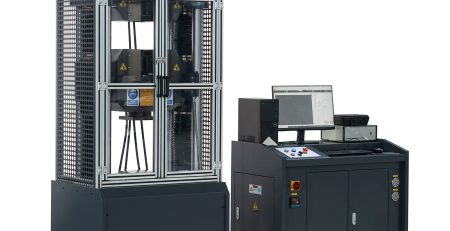
1. Elektronikong unibersal na makina ng pagsubok
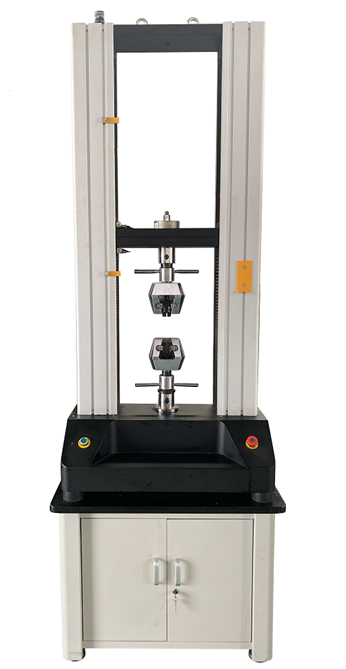
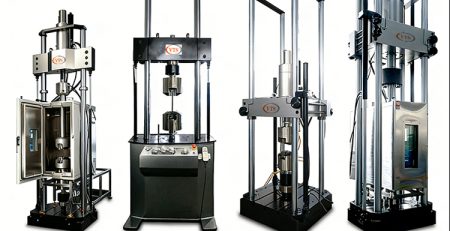
(Schematic diagram: The universal material testing machine can be used with different fixtures to perform different mechanical tests)
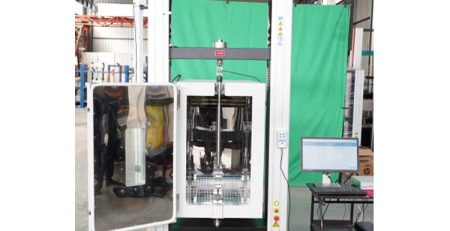
2. Customized Compression Fixtures

3. Test conditions
Test temperature: room temperature, about 20°C
Load sensor: 100KN (0.5 level)
Uri ng pagsubok: compression test
Test speed: 0.2 mm / min
4. Test process

Step 1. Test equipment and tool preparation
1. Elektronikong unibersal na makina ng pagsubok: Select an electronic universal testing machine with a range of 100kN (accuracy level 0.5) to ensure that the equipment is calibrated and operates normally.
2. Customized compression fixture: including upper and lower spherical pressure plates to ensure that the surface of the pressure plate is smooth and undamaged.
3. Auxiliary tools:
Carbide contact block (hardness HV1500, size Φ25×20 mm).
35 μm thick polytetrafluoroethylene film gasket.
Vernier caliper or other measuring tools to check the parallelism of the pressure plate.
Step 2. Test condition setting
1. Test temperature: Ensure that the test environment temperature is room temperature (about 20°C) and record the ambient temperature and humidity.
2. Uri ng pagsubok: Set the test machine to compression test mode.
3. Test speed: Set the test speed to 0.2 mm / min.
4. Load sensor: Select a 100kN load sensor and confirm that its accuracy level is 0.5.
Step 3: Halimbawa ng paghahanda
Check the appearance of the ceramic compression sample to ensure that there are no cracks or defects on the sample surface and that the size meets the standard requirements.
Clean the sample surface, remove dust and impurities, and ensure good contact between the sample and the contact block and the sheet gasket.
Step 4: Assemble the test device
1. Adjust the parallelism of the pressure plate:
According to the standard requirements, adjust the lower spherical pressure plate to ensure that the parallelism of the upper and lower pressure plates is less than 20 M.
Use special tools or measuring equipment to check the parallelism and make fine adjustments if necessary.
2. Place the sample assembly:
Place the carbide contact block, 35 μm thick polytetrafluoroethylene film gasket and ceramic compression sample on the lower spherical pressure plate in turn to ensure that the components are tightly fitted and centered.
3. Install the upper pressure plate: Install the upper spherical pressure plate in place to ensure that it has good contact with the sample assembly.
3. Result recording and analysis:
Record the test results in the test report, including test conditions, specimen size, maximum load, compression strength, atbp.
Analyze the fracture morphology of the specimen, and explore the factors affecting the compression strength in combination with factors such as microstructure.
The above is Andy Li’s sharing about the fine ceramic compression strength test. I hope it can be helpful to everyone! If you want to know more about the fine ceramic compression strength test method, test equipment, test standards, test reports, test videos and test methods, universal material testing machine specifications, extensometer installation, instructions, operating procedures and uses, electronic universal testing machine usage, verification procedures and elastic modulus test, atbp., you are welcome to follow us, or you can send us a private message and leave a message. The VTS measurement and control technology team will answer you for free!